
A Gentle Movement Routine for Stiff Knees, Hips and Hands (No Equipment)
Updated November 23, 2026 · By the artibrexjoints.com editorial team · How we write these guides
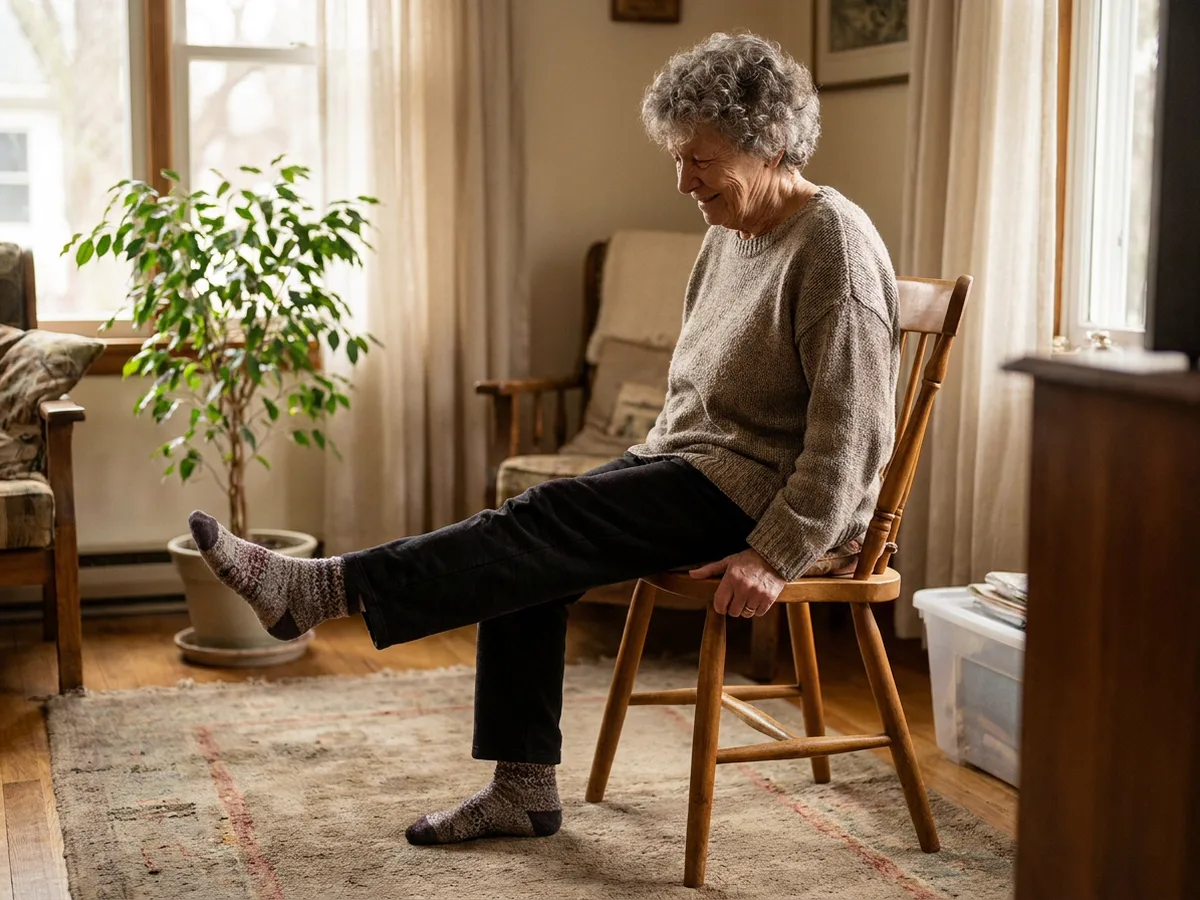
The single most recommended thing for stiff, achy joints after 60 is regular, gentle movement. A short routine you actually do every morning and evening, plus walks spread through the week, keeps knees, hips and hands moving more freely than any one big workout.
Below is a simple plan in three parts: a ten-minute morning wake-up for the knees and hips (most of it in bed or on a chair), a five-minute hand routine at the kitchen table, and a weekly walking and strength plan that builds toward the activity levels the CDC recommends for older adults. Everything can be done at home, with no equipment beyond a sturdy chair.
Before you start: if you have had a joint replacement, a recent fall, heart or lung problems, or a joint that is hot and swollen, ask your doctor or a physical therapist which moves are right for you. Move within comfort: mild stretching is fine, sharp pain means stop.
Why does gentle movement help stiff joints?
Joints are built to move. Moving pushes the slippery fluid inside the joint around the cartilage, warms up the muscles and tendons around it and keeps the range of motion you have. Strong muscles around the knee and hip also take some of the load off the joint itself.
That is why the 2019 American College of Rheumatology and Arthritis Foundation guideline strongly recommends exercise for osteoarthritis of the knee, hip and hand, and also strongly recommends tai chi for the knee and hip. The CDC suggests that older adults aim for at least 150 minutes of moderate activity across the week, such as brisk walking, plus muscle-strengthening activities on at least two days and activities that improve balance. If you are far from that today, start small; any amount is better than none.
Part 1: the 10-minute morning routine (knees and hips)
In bed, on your back
- Ankle pumps: point and flex both feet, 20 times.
- Heel slides: slide one heel toward your bottom, bending the knee as far as comfortable, then slide it back. 10 per leg.
- Quad squeezes: legs straight, press the back of the knee down into the mattress, tightening the front of the thigh. Hold 5 counts. 10 per leg.
- Knee rocks: knees bent, feet flat, let both knees sway gently side to side, 10 times. This loosens the hips and lower back.
- Bridges: knees bent, squeeze your seat and lift your hips a few inches. Hold 3 counts, lower slowly. 8 times.
Sitting on the edge of the bed or a sturdy chair
- Leg swings: let each lower leg swing gently forward and back, 15 times.
- Seated knee straightening: slowly straighten one knee until the leg is out in front, hold 3 counts, lower. 10 per leg.
- Marching: lift one knee a few inches, then the other, like slow marching. 10 per side.
- Sit-to-stand: feet under your knees, lean forward ("nose over toes") and stand up, then sit back down slowly. 5 times, using your hands if needed.
Then take a warm shower. Heat helps loosen stiff joints, and many people find the combination of these moves plus warm water makes the first hour of the day far easier. More on mornings in stiff knees in the morning.
Part 2: the 5-minute hand routine
Do this at the kitchen table, ideally after running your hands under warm water:
- Open and close: make a loose fist with the thumb outside, then spread the fingers wide. 10 times.
- Thumb to fingertips: touch the thumb to each fingertip to make an "O". 3 rounds.
- Tabletop lifts: palm flat on the table, lift each finger one at a time. 2 rounds.
- Finger slides: palm flat, spread the fingers apart and bring them back together. 10 times.
- Wrist circles: slow circles in both directions, 10 each way.
- Gentle squeeze: squeeze a soft foam ball for 3 counts, release. 10 times.
For grip tools and other hand tips, see stiff hands and fingers.
Part 3: the weekly plan
| Day | Walk | Strength and balance |
|---|---|---|
| Monday | 10 to 20 minutes, easy pace | Sit-to-stand, bridges, standing side leg lifts at the counter |
| Tuesday | 10 to 20 minutes | Balance: stand on one foot holding the counter, 10 to 20 seconds each side |
| Wednesday | Rest or a gentle stroll | Hand routine only |
| Thursday | 10 to 20 minutes | Repeat Monday's strength moves |
| Friday | 10 to 20 minutes | Balance plus heel raises at the counter |
| Saturday | A longer, enjoyable walk: park, mall, garden | Optional tai chi or water exercise class |
| Sunday | Rest | Gentle stretching |
Every week or two, add a few minutes to the walks. When 20 minutes feels comfortable, aim for longer walks or a brisker pace on some days. Water exercise is a great option on stiff days because the water supports your weight. Many community centers and the Arthritis Foundation offer gentle group programs designed for people with arthritis.
How hard should it feel?
A good rule many therapists use: some mild soreness during or after exercise is normal, but it should settle within a couple of hours. If a joint is more painful the next day than before you started, do a little less next time rather than stopping altogether. Swelling, a joint that feels hot, or pain that makes you limp are signs to back off and check with your doctor.
- Warm up with the morning moves before a walk.
- Wear cushioned, supportive shoes and choose level paths at first.
- Use a cane in the hand opposite a sore knee or hip on bad days; it is a tool, not a defeat.
- Drink water and choose cooler times of day in summer.
Where does a joint supplement fit in the routine?
Movement comes first. A supplement can be one more small habit that sits next to it. ArtiBrex Joint Mobility Support is taken in the morning as directed on the label, which makes it easy to pair with the routine above: capsules with your morning glass of water, then the ten-minute wake-up. The label describes it as supporting healthy joints, flexibility, cartilage function and comfortable movement, with Okinawan ginger, a protected B-vitamin complex, undenatured type II collagen and Boswellia serrata in every capsule. It is not a treatment for arthritis.
The routine also gives you the perfect way to judge any supplement: you will notice whether the sit-to-stands get easier, whether you take the stairs facing forward, and how far the Saturday walk goes. Check at the end of each bottle; the brand's 90-day money-back guarantee, counted from the purchase date, covers the 3-bottle package.
| Package | Price today | Per bottle | Regular | Off |
|---|---|---|---|---|
| 3 bottles | $99 | $33 | 78% | |
| 2 bottles | $89 | $44.50 | 70% | |
| 1 bottle | $79 | $79 | 47% |
Shipping is free within the USA. The charge appears as BEMONY*ARTIBREX. To ask for a refund within the 90 days, email support@artibrex.com.
Keep it going
The best routine is the one you still do in three months. Put the hand routine next to the coffee maker, the knee moves before you get out of bed and the walks on the calendar like appointments. If your hips are the main problem, read aching, stiff hips for sleeping and sitting tips, and if you are over 60 and planning for the years ahead, see joint stiffness after 60.
Questions people ask
What is the best exercise for stiff joints over 60?
Regular, gentle movement: walking, strength moves like sit-to-stands and bridges, tai chi and water exercise. Exercise is strongly recommended for knee, hip and hand osteoarthritis.
How much activity do older adults need?
The CDC suggests at least 150 minutes of moderate activity across the week, plus muscle strengthening on two days and balance activities. Start small and build up.
Should exercise hurt?
Mild soreness that settles within a couple of hours is normal. Sharp pain, swelling or more pain the next day means doing less next time.
Is it better to exercise in the morning or evening?
Whenever you will do it consistently. Many people with stiff joints like a short routine in the morning to loosen up and a walk later in the day.
Can I do these exercises after a joint replacement?
Ask your surgeon or physical therapist first; they will give you a plan for your new joint.
Where does ArtiBrex fit in a movement routine?
It is a morning capsule, taken as directed on the label, that can sit alongside the routine. Movement comes first.
Keep reading
Sources
- CDC: Physical activity for older adults
- CDC: Arthritis
- Arthritis Foundation: Osteoarthritis
- Kolasinski SL et al. 2019 ACR/Arthritis Foundation osteoarthritis guideline. Arthritis & Rheumatology, 2020
This guide is general information for adults, not medical advice. ArtiBrex is a dietary supplement; it is not a treatment for arthritis or any disease. If you take medication, have surgery planned or have a medical condition, talk to your doctor first.